


If you’re new here: I’m Amanda Carroll — dating strategist, former nationally syndicated radio host, and your personal dating and relationship coach. This Substack is your playbook. Every week I hand you one play: a named, specific action you run in your own life that week. Not a theme. Not a mood. A play. Study it, run it, and watch what changes.
What if one of the biggest things keeping you stuck isn’t what happened to you—but the movie you keep replaying about what happens next?
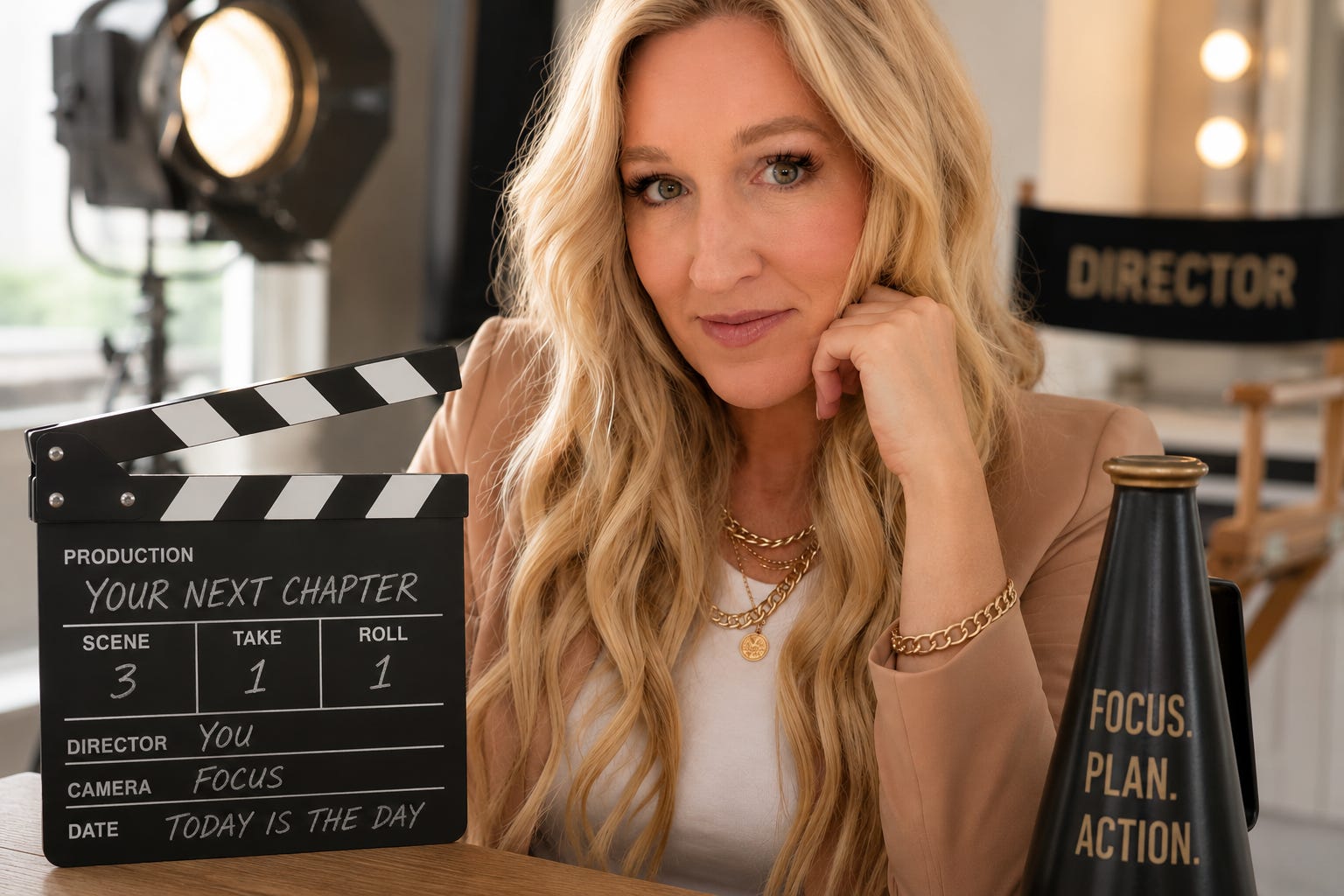
“I’ll never recover financially from this divorce.”
“There are no good men on dating apps.”
“I’m too old to start over.”
“I wasted the best years of my life.”
“I’ll never find another job that pays me this well.”
“I’m going to be alone forever.”
We say these things like we’re reporting the news. But we’re not. We’re predicting the future.
And if you’ve been through something painful—a divorce, betrayal, job loss, financial upheaval, heartbreak—you can get really, really good at predicting disaster. Your brain has evidence. It knows what happened last time. So it starts showing you the sequel before the next chapter has even begun.
This week, we’re going to give it a new script.
THIS WEEK’S PLAY: THE MIND MOVIE
The Mind Movie is a detailed mental script of the life you want to create next.
Not a vision board. Not an affirmation. And definitely not me telling you to visualize a Range Rover in your driveway and wait for the universe to drop the keys through your sunroof.
We’re going to use visualization, attention and behavioral science to do something much more practical: deliberately rehearse a different future—and then start making decisions that support it.
Because there’s some fascinating research behind why this may matter.
THE SCIENCE THAT MADE ME OBSESSED WITH THIS
I first became interested in this idea after hearing about visualization and future-oriented practices being used in addiction recovery. I went digging into the research, and what I found was even more interesting than the story I originally heard.
In a randomized clinical trial published in JAMA Psychiatry, researchers followed 286 people who had completed treatment for substance-use disorders. Participants received mindfulness-based relapse prevention, traditional relapse prevention or treatment as usual. At six months, the two relapse-prevention groups showed a 54% lower risk of drug relapse and a 59% lower risk of heavy-drinking relapse compared with treatment as usual.
To be clear: the researchers were not testing something called a “Mind Movie,” and I don’t want to pretend they were. But they were demonstrating something important: changing how people respond to thoughts, cues, cravings and old behavioral patterns can change what happens next.
Then I found research published in 2026 from Texas A&M that absolutely fascinated me. Researchers studying alcohol relapse identified different groups of neurons associated with alcohol-seeking behavior and with extinction—the newer learning that the alcohol-associated behavior was no longer rewarded. The old memory didn’t simply disappear. The newer learning existed alongside it, essentially competing for control over behavior.
Think about that for a second.
You don’t necessarily have to erase the old movie before you start creating a new one.
That matters to me because I work with women who sometimes believe they have to completely heal, completely forget, completely forgive, completely stop being afraid and somehow become a brand-new human before they can move forward.
Maybe you don’t.
Maybe you can start building the new story while the old one still exists.
AND THEN THERE’S YOUR RAS
You’ve probably heard people on the internet talk about the Reticular Activating System, or RAS, like it’s some sort of manifestation button in your brain.
Tell your RAS you want a husband and apparently a 6’2”, emotionally available man with a retirement account will materialize next to the organic avocados at Whole Foods.
I wish.
The actual science is less magical and much more useful. The reticular activating system is involved in things like arousal, wakefulness and attention. Your brain is constantly filtering an overwhelming amount of information and deciding what deserves your attention.
That’s why you decide you want a white Range Rover and suddenly there are white Range Rovers EVERYWHERE. They didn’t appear overnight. Your attention changed.
Now apply that to your life.
If you’ve decided, “There are no good men on dating apps,” what are you looking for every time you open Hinge?
Proof.
Fish picture? Proof.
“Figuring out my dating goals” at 52? Proof.
Guy turns the conversation sexual before he knows your last name? PROOF.
You’re building a case.
And eventually, something you’ve repeated enough stops feeling like a belief and starts feeling like a fact.
That’s why this week we’re making a new movie.
I DID THIS BEFORE I KNEW WHAT I WAS DOING
Before I met my husband, I did something almost every night.
I fell asleep listening to audio hypnosis about being in love.
I wasn’t trying to manifest a particular man. I didn’t have Sean’s face pasted onto a vision board somewhere.
I was practicing the feeling of something that, after everything I had been through, didn’t necessarily feel familiar anymore.
Being safely loved. Being consistently loved. Being with someone who wanted to be there. Being able to be completely myself inside a relationship. Having love feel peaceful instead of precarious.
I had already spent plenty of years rehearsing how badly love could go.
I was excellent at that.
I needed to practice a different movie.
And I don’t believe listening to hypnosis magically delivered my husband to me. I believe something much more powerful happened: when healthy love stopped feeling impossible, I started making different decisions about who got access to me.
That is what I want you to practice this week.
And this doesn’t have to be about finding a man.
Maybe you’re rebuilding after divorce. Maybe you’re looking for a new career. Maybe you’re trying to become financially independent. Maybe you’re starting a business. Maybe your kids are leaving home and you have no idea who you are without being needed every second of every day.
Whatever part of your life feels stuck, we’re going to write a new script for it.
HOW TO RUN THE PLAY
Grab your journal, your Notes app or a blank Google Doc. I want you to actually write your Mind Movie. Give yourself 20 minutes the first time. After that, you’ll be able to replay it in your head in just a few minutes.
1. NAME THE OLD MOVIE
Start with the story you’re currently telling yourself.
And don’t give me the enlightened version you think you’re supposed to say. Write the ugly one.
“I’m 47, divorced and no one is ever going to choose me again.”
“I will never financially recover from this divorce.”
“There are no good men on dating apps.”
“I stayed home with my kids for 15 years and nobody is going to hire me.”
“I’m too old to start over.”
“I wasted the best years of my life.”
Write it down.
That is the movie you’ve been rehearsing.
2. CHOOSE THE NEW ENDING
Now ask yourself:
If this worked out better than I currently believe is possible, what would my life look like one year from today?
Choose ONE area of your life for your first Mind Movie: love, career, money, divorce recovery, home, friendship, confidence, health—whatever needs a new story.
And be careful with your language.
“I’m not lonely anymore” is still a movie about loneliness.
“I don’t hate my job anymore” is still a movie about the job you hate.
Instead: “I have built a life I genuinely love waking up to.”
That’s where we’re going.
3. WRITE A SCENE, NOT AN AFFIRMATION
This is the most important part.
Don’t write: “I am happy.”
Show me happy.
Where are you? What time is it? What are you wearing? Who is there? What can you hear? What are you doing? What aren’t you worried about anymore? What does your body feel like?
If your Mind Movie is about love, don’t picture the wedding. Picture Tuesday.
You’re making dinner. He walks into the kitchen. You’re sitting beside him at your son’s baseball game. You’re driving home from Costco. You disagree about something and nobody threatens to leave. You know where you stand.
If your Mind Movie is about your career, don’t picture the LinkedIn announcement.
Picture Monday morning.
Where are you working? What are you doing at 10:17 a.m.? Who are you talking to? How do you feel opening your laptop?
If you’re rebuilding after divorce, don’t picture yourself triumphantly declaring that you’re healed.
Picture Saturday morning.
You wake up, make coffee and realize you’re excited about your own life. You have plans you actually want to do. The house feels like yours. You realize you haven’t thought about your ex since yesterday.
That’s a Mind Movie.
4. WRITE IT IN FIRST PERSON, PRESENT TENSE
Don’t write: “Someday I’ll wake up and feel peaceful.”
Write:
“I wake up Saturday morning and sunlight is coming through my bedroom window. The house is quiet. I make coffee and sit outside. I look at my calendar and I’m excited about what I have planned today. I feel peaceful in my own home. I’m proud of the life I’ve built.”
Write your movie as though you’re inside the scene.
5. DECIDE HOW SHE FEELS
Now ask yourself: How does the woman in this movie feel?
Safe? Free? Wanted? Capable? Peaceful? Sexy? Successful? Secure? Loved? Proud?
Because sometimes the thing we think we’re chasing isn’t actually the thing.
Maybe you think you want the husband, but what you’re really craving is safety and partnership.
Maybe you think you want the promotion, but what you really want is freedom and respect.
Maybe you think you need your ex to finally admit what he did, but what you really want is peace.
Identify the feeling.
That’s what we’re actually building toward.
6. NOW NAME WHAT COULD STOP HER
This is the part that keeps The Mind Movie from becoming wishful thinking.
Psychologist Gabriele Oettingen has spent decades researching positive fantasies and something called mental contrasting. One of the fascinating findings from this body of work is that simply fantasizing about the future we want isn’t necessarily enough. In some circumstances, positive fantasies alone can actually reduce the effort we put toward achieving them.
So after you see the future, look at reality.
Ask yourself:
What inside me could keep this movie from becoming my life?
Fear?
Going back to the wrong man?
Never actually putting yourself on the dating apps?
Staying in a job you hate because it’s comfortable?
Waiting until you “feel ready”?
Avoiding your finances because looking at them scares you?
Continuing to believe the old story because at least it’s familiar?
Name the obstacle.
Now we’re getting somewhere.
7. GIVE THE WOMAN IN YOUR MOVIE HER NEXT MOVE
Finish this sentence:
The woman in my Mind Movie would...
Update her résumé.
Delete his number.
Download the dating app.
Call the financial planner.
Apply for the job.
Take herself to dinner.
Sign up for the class.
Ask for the raise.
Say yes to the invitation.
Say no to the situationship.
Book the trip.
Make the appointment.
Then choose ONE thing and do it within the next 24 hours.
Because we’re not just thinking about a different life.
We’re practicing becoming the woman who creates it.
YOUR PLAY FOR THE WEEK
For the next seven nights, replay your Mind Movie before you go to sleep.
You don’t have to read the entire script every night. Close your eyes and put yourself inside the scene. See it. Hear it. Feel it.
And then every morning ask:
What would the woman in my Mind Movie do today?
Do one thing.
That’s it.
Write it. See it. Feel it. Make the move.
Because what I love most about this exercise isn’t the idea that if you think about something hard enough, the universe will eventually hand it to you.
I don’t believe your life works that way.
I believe something better:
When you change what you believe is possible for your life, you start noticing different possibilities—and making different choices.
You don’t have to erase the old movie first.
You just have to stop letting it write every sequel.
AND IF THE MOVIE YOU NEED TO CHANGE IS YOUR DATING LIFE...
I have something new coming.
Because maybe your old movie sounds like this:
“There are no good men on dating apps.”
“I keep choosing the wrong men.”
“Dating never works for me.”
“I don’t even know what I’m supposed to be looking for anymore.”
Then I want to help you reset more than your mindset.
I’m creating The Dating Reset Training Camp for women who are ready to completely change the way they approach dating, evaluate men and choose their next relationship.
Your Mind Movie gives you a vision of where you’re going.
The Dating Reset is where we’ll start changing the way you date so your actions can actually take you there.
JOIN THE DATING RESET TRAINING CAMP
You are allowed to write a different ending.
But this time, we’re not just going to watch the movie.
We’re going to make the moves that create it.
See you next week,
Amanda